Paraguay Achieves Investment Grade: Investment Opportunity and a Model for the Region
A guest article by Santiago Casas

Recently, Moody’s upgraded Paraguay’s credit rating, a move that brings opportunities and benefits for both the country and investors. This news marks a significant milestone and has far-reaching implications, not only for Paraguay’s economy but also for the Southern Cone region.
From an investor’s perspective, an improved credit rating signals increased confidence in Paraguay’s economic and fiscal stability. A better rating reduces perceived risk, resulting in lower borrowing costs. This makes Paraguay a more attractive destination for foreign direct investment and capital flows. With lower associated risk, investors are more likely to inject funds into the country, potentially leading to a significant increase in capital inflows. For Latin American economies, which often lack substantial domestic savings, international capital support is crucial for fostering economic growth, as it can finance infrastructure projects, boost the private sector, and improve the general well-being of the population.
Moody’s stated, “The upgrade of Paraguay’s rating reflects a combination of factors, including robust and sustained economic growth and our expectations that the economy has become more resilient to shocks.” In this way, the country joins the ranks of Chile, Uruguay, Peru, Colombia, Brazil, and Panama.
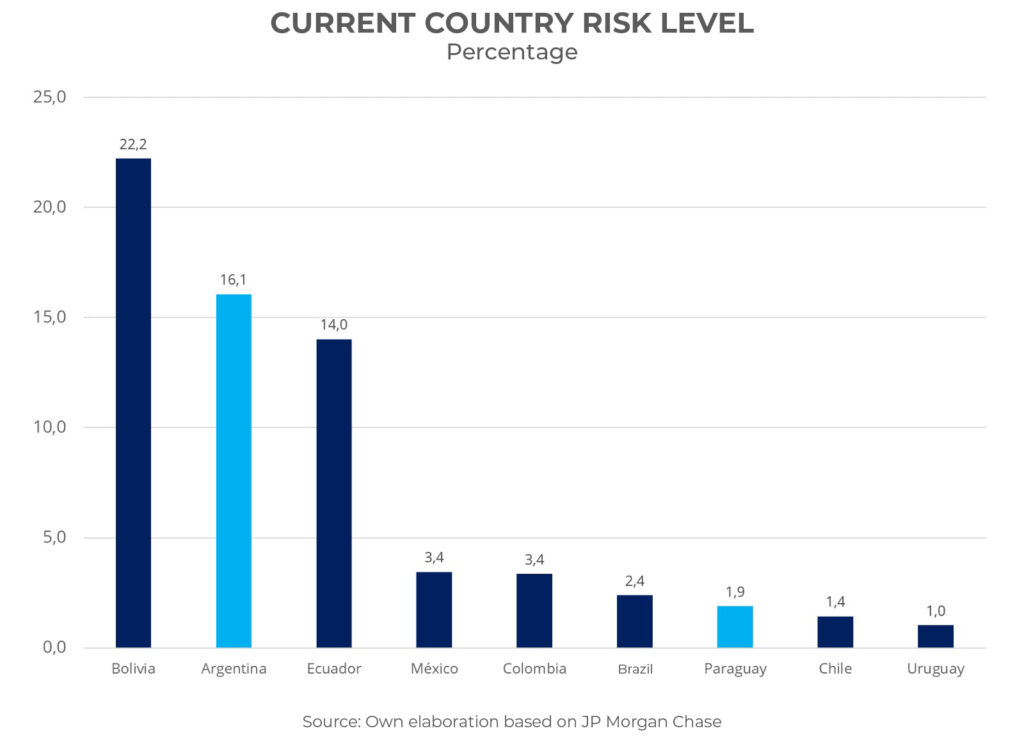
For Paraguay, this upgrade not only means access to financing at more favorable rates but also greater visibility and credibility in the international market. This can strengthen the country’s position in trade negotiations and attract multinational companies seeking a stable and predictable economic environment for their operations. The upgrade also reflects prudent public finance management and a commitment to sound macroeconomic policies, which in turn reinforces investor confidence.
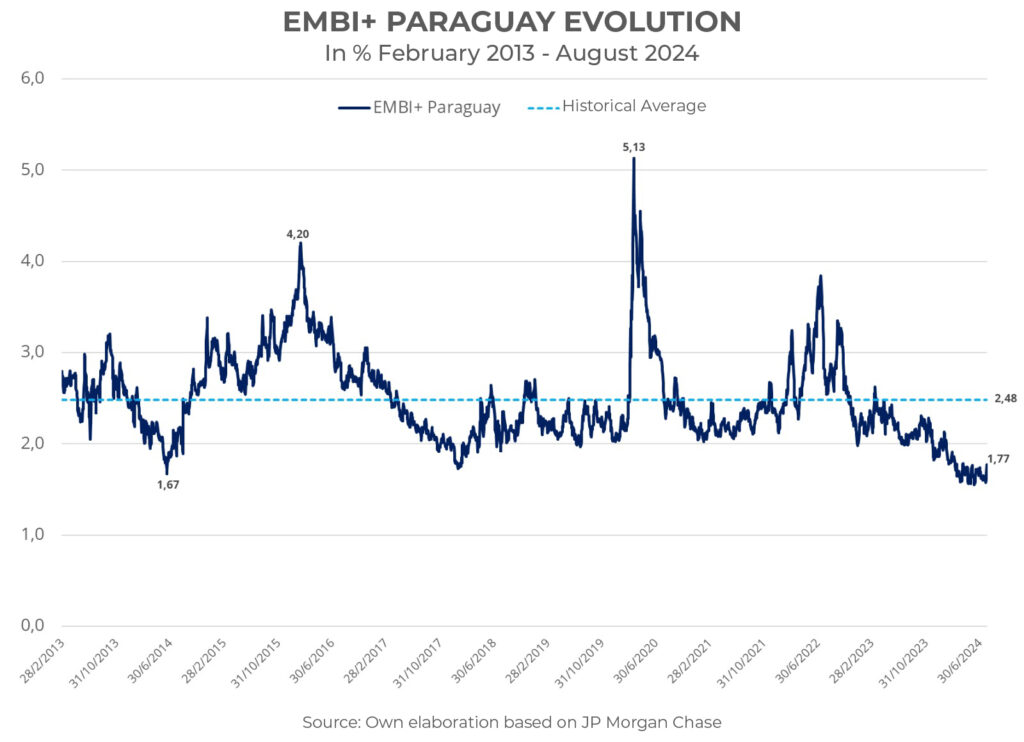
The EMBI+ index, conducted by JP Morgan Chase, reflects this success. The country has managed to establish itself at country risk levels below the average of the last decade. Today, this figure stands at around 177 basis points (1.77%), consolidating a process of reducing the market’s required return to finance the country’s public accounts. After reaching a level of 384 basis points in July 2022, two years later we see that the country risk has halved (-51%).
In the regional context, Paraguay’s progress represents an encouraging example for other Southern Cone countries, especially for Argentina. Argentina, which has faced dramatic economic challenges in recent years, now finds itself aligned with the fiscal discipline and stable economic policies implemented by Paraguay. While Argentina’s credit rating improvement still seems a distant goal, it is not unattainable. To continue improving its rating, Argentina would need to implement structural reforms that address its debt issues, inflation, and consolidate fiscal surplus, in addition to creating a more favorable investment environment by lowering taxes and eliminating growth-hindering regulations.
The difference between the credit ratings of Paraguay and Argentina highlights the importance of prudent and consistent economic governance. While Paraguay has demonstrated a commitment to stability and sustainable growth, Argentina must tackle and overcome its internal challenges to follow the same path. This requires political will, social consensus, and a long-term vision that transcends electoral cycles.
Moody’s upgrade of Paraguay’s credit rating is more than just financial recognition; it is a validation of prudent economic policies and an open door to a more promising future. It represents a vote of confidence in the country’s economy and opens doors to new investment and growth opportunities. For the Southern Cone region, it serves as a reminder of the positive impact that sensible economic policies and prudent fiscal management can have. It remains to be seen whether neighboring countries will capitalize on Paraguay’s experience to undertake the necessary reforms that lead to sustainable recovery and improvement in their credit ratings.
About the Author
Santiago holds a Bachelor’s degree in Economics from UCEMA and is also a Master’s candidate in Finance at the same University in Buenos Aires. He worked as an Economic Analyst at various prestigious institutions like the Fundación Libertad y Progreso, a liberal think tank, or the Public Secretary of Industry and Commerce. He has written dozens of articles for Argentina’s leading economic media outlets.
Linkedin